Gov’t proposes nearly VND 290 trillion Ring Road 5 project for Ha Noi Capital Region
VGP - The Government submitted to the National Assembly a proposal to invest in Ring Road 5 of the Hanoi Capital Region, a major expressway project with a preliminary investment of nearly VND 290 trillion (approximately US$11 billion) aimed at strengthening regional connectivity and supporting long-term socio-economic development.
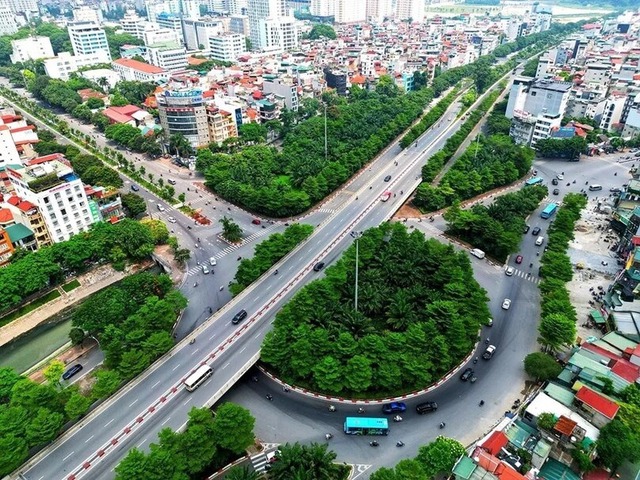
Illustration photo
Presenting the proposal on behalf of the Government, Minister of Construction Tran Hong Minh said the project would create a strategic transport corridor linking Ha Noi with surrounding localities, ease traffic congestion, reduce environmental pollution, and complete the capital's ring road network.
The proposed route is approximately 349 kilometers long and will pass through seven localities: Ha Noi, Ninh Binh, Hung Yen, Hai Phong, Bac Ninh, Thai Nguyen, and Phu Tho.
The project comprises a six-lane expressway designed for speeds of 100–120 km/h and parallel roads with at least two lanes designed for speeds of 60–80 km/h.
According to the Government, the alignment has been selected to comply with approved planning, minimize route length and land acquisition, and has received written agreement from all seven affected localities.
The project is expected to require around 4,011 hectares of land, with compensation, support and resettlement costs estimated at about VND 78.1 trillion.
The Government proposed implementing the project through a combination of public-private partnership (PPP) and public investment.
The preliminary total investment is estimated at VND 288.3 trillion, including VND 215.2 trillion for the main expressway financed by the central budget and VND 73.1 trillion for the parallel roads funded by local budgets.
Around VND 59.7 trillion is expected to be allocated during the 2026–2030 medium-term public investment plan.
Under the proposed timeline, project preparation would begin in 2026, construction would commence in 2027, and the main works would be substantially completed by 2030. The remaining sections would continue to be implemented thereafter, with the Government aiming to complete the entire route before 2035 by mobilizing additional capital sources.
National Assembly committee calls for further review
Presenting the verification report, Chairman of the National Assembly's Economic and Finance Committee Phan Van Mai requested the Government to review and harmonize all data in the project dossier and the accompanying draft resolution before it is submitted for approval.
The committee also called for further clarification of the project's financing plan, including the structure of capital sources, the schedule for capital allocation, and the ability of both the central and local budgets to meet funding requirements, particularly for Ha Noi and Hai Phong, which are expected to contribute significant resources.
It also recommended assessing the project's impact on the 2026–2030 medium-term public investment plan in the context of other nationally important infrastructure projects being implemented during the same period.
The committee urged the Government to obtain formal commitments from all seven localities regarding the allocation of local budget funding for the parallel roads as well as compensation, support and resettlement activities.
Some members suggested considering a phased investment approach, noting that only about VND 59.7 trillion has currently been identified for the 2026–2030 period. They proposed implementing the project in phases consistent with available funding to ensure feasibility and investment efficiency.
The verification report also recommended reviewing data related to affected rice land, forest land and defense land, as well as the number of households requiring relocation. It called for adequate preparation of resettlement areas, livelihood restoration measures, and a comprehensive plan for construction materials, disposal sites and environmental protection to ensure legal compliance and sustainable implementation.
So far, Ha Noi's four main ring roads (beltways) form the backbone of the capital's transport network, connecting radial highways, reducing congestion in the city center, and opening new urban development areas.
Ring Road 1 serves the historic urban core and carries dense local traffic. Ring Road 2: distributes traffic around the inner city and links major river crossings. Ring Road 3: Functions as Ha Noi's principal urban expressway, connecting key expressways and industrial areas. Ring Road 4: Designed as a strategic regional corridor to support logistics, industrial parks, satellite cities, and long-term urban expansion across the Capital Region.
In addition to these four main ring roads, Ha Noi's transport master plan also includes Ring Roads 2.5, 3.5, and 5, with a future Ring Road 4.5 proposed to support economic development corridors./.