
Ha Noi completes tunneling for four underground stations of 2nd metro line
VGP - The first Tunnel Boring Machine (TBM) used for the Nhon–Ha Noi Station metro line has finished its entire tunneling route, marking a significant milestone in Viet Nam’s urban underground construction.
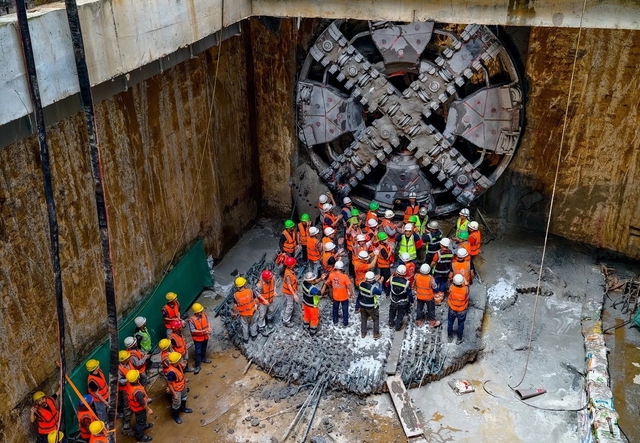
The twin Tunnel Boring Machines, "Than Toc" and "Tao Bao," are designed specifically for the Nhon-Hanoi Station metro line. Photos: The Hanoi Metropolitan Railway Management Board
According to the Ha Noi Metropolitan Railway Management Board (MRB), TBM No.1—named Than Toc (Lightning Speed)—reached Station S12 on December 1, completing its drive through the project's first four underground stations.
Launched on July 30, 2024, Than Toc traveled from Station S9 (Kim Ma), through Stations S10 (Cat Linh) and S11 (Van Mieu), before arriving at its final destination at Station S12. This marks the first time Ha Noi has deployed a TBM in its densely populated and historically sensitive city center, representing a major step forward in constructing the nearly four-kilometer underground section of the metro line.
A second TBM, Tao Bao (Bold), is continuing excavation on the remaining tunnel segment and is advancing toward Station S11.
As of December 1, the contractor reported that Package CP03—which covers underground tunnels and stations—had surpassed 72 percent completion.
Nguyen Ba Son, Deputy Head of the MRB, described the breakthrough at Station S12 as a historic achievement reflecting the sustained efforts of engineers and construction teams.
"The tunneling was executed under strict safety protocols with support from international experts, helping overcome numerous technical challenges. The successful performance of TBM No.1 strengthens confidence in the progress of TBM No.2," Son said.
Park Young, Project Director for the Hyundai-Ghella joint venture—the main contractor for the Nhon–Ha Noi Station metro line—noted that Ha Noi's geological conditions are complex, and the surface environment includes a mix of new and old buildings as well as cultural and historical sites.
"The safe operation of TBM No.1 demonstrates that Vietnamese engineers and contractors are increasingly capable of mastering advanced underground construction technologies," he said.
Park added that the Nhon–Ha Noi Station metro line is one of the city's most important transport projects and is expected to become a vital artery that reduces congestion, encourages public transport use, and enhances urban environmental quality.
"Construction of the underground section is being carried out with a strong focus on safety, quality and maintaining progress toward planned milestones," he emphasized.
The TBMs used for the project were custom-designed and manufactured by German firm Herrenkecht. Each machine is more than 100 meters long, weighs about 850 tons, and features a rotating cutting wheel with a diameter of 6.55 meters. They are designed to excavate roughly 10 meters of tunnel per day.
Ha Noi's second metro line, the Nhon–Ha Noi Station route, stretches 12.5 kilometers from the Nhon area in Tu Liem District along Kim Ma Street to Ha Noi Railway Station on Le Duan Street. With a total investment of VND 36 trillion (US$1.56 billion), the urban railway includes 8.5 kilometers of elevated tracks across eight stations and a four-kilometer underground section.
Earlier, on August 9, 2024, the 8.5-kilometer elevated section of the Nhon-Ha Noi Station metro line was commissioned. Work on the metro line began in September 2010 and was originally scheduled to be completed in 2016. However, the project was delayed several times for various reasons, increasing the total investment from US$712 million to US$1.4 billion. The metro line consists of 10 trains with a maximum speed of 80 kilometers per hour. Each train has four cars, with a maximum capacity of 236 passengers per car. The line is operated by a total of 353 employees./.