Ha Noi to break ground on five major metro lines
VGP - Ha Noi is set to launch construction of five major metro lines on June 22, marking a significant milestone in the capital’s efforts to modernize its transport infrastructure and reshape urban development.
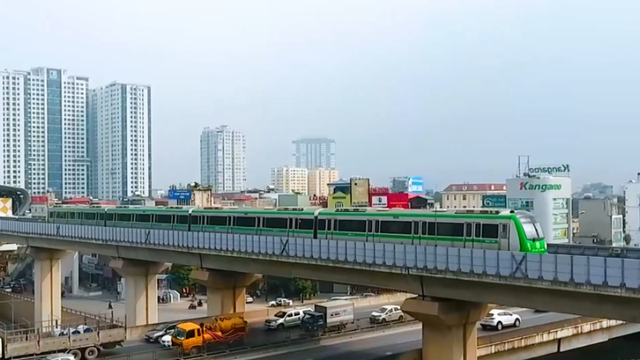
The simultaneous commencement of the five urban railway projects signals a new chapter in Ha Noi's transport strategy, reflecting a shift from developing individual lines to implementing a coordinated network approach aimed at accelerating the expansion of high-capacity public transportation.
According to Nguyen Ba Son, Deputy Director of the Ha Noi Metropolitan Railway Management Board (MRB), the large-scale rollout represents a fundamental change in investment planning, enabling the city to build an integrated and interconnected metro system within a shorter timeframe.
Under Ha Noi's 2021–2030 master plan, the city intends to develop 18 urban railway lines spanning nearly 979 kilometers. Authorities aim to complete about 500 kilometers of the network by 2035, with the remainder scheduled for implementation between 2035 and 2045.
The five metro lines scheduled to begin construction are expected to serve as key transport corridors, supporting Ha Noi's transition toward a polycentric urban model. Beyond reducing traffic congestion, the projects are expected to unlock new development areas, stimulate the growth of satellite urban zones, and facilitate the revitalization of existing neighborhoods.
The projects benefit from a series of special policy mechanisms approved by the National Assembly, including Resolution 188/2025/QH15, Resolution 258/2025/QH15, and the revised Law on Capital. These frameworks streamline investment procedures, shorten project preparation timelines, and allow land clearance activities to proceed independently, helping ensure timely site handover for construction.
MRB officials noted that all five routes play strategic roles in the future urban transport network. The lines are targeted for completion by 2030 and will be integrated with Metro Lines 3 and 5 to form a comprehensive public transport system across the capital.
At the same time, Ha Noi is accelerating work on Metro Line 3, particularly its underground section, with a goal of completing the entire route by the end of 2027. Metro Line 5 is currently in the final design stage and undergoing a dual-use feasibility assessment under Government direction.
Once completed, the five new metro lines are expected to usher in the most extensive phase of transport infrastructure development in Ha Noi's history, supporting economic growth while advancing the city's vision of becoming a green, smart, and sustainably connected metropolis.
Five key metro routes
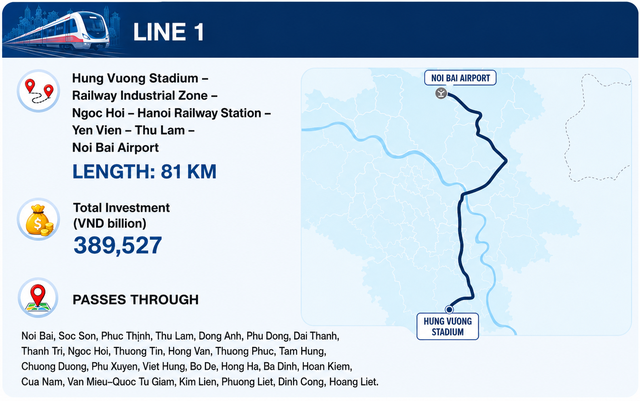
Line 1 (81 km): Connects Hung Vuong Stadium, Ngoc Hoi, Ha Noi Station, Gia Lam, and Noi Bai International Airport, serving as a vital north-south corridor linking urban rail with the national railway network, high-speed rail, and the airport.
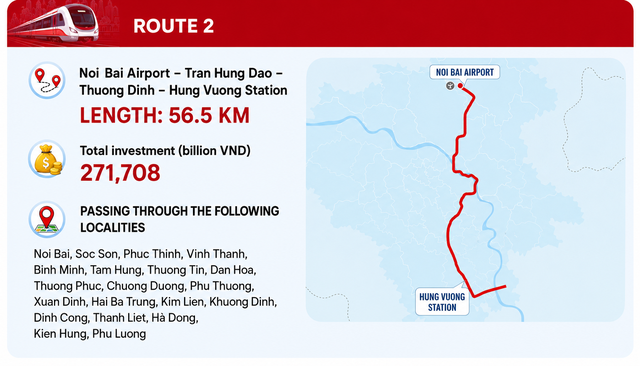
Line 2 (56.5 km): Runs from Nam Thang Long through Hoan Kiem Lake, Tran Hung Dao, Thuong Dinh, and southern urban areas, providing another major connection to Noi Bai International Airport while traversing the city center.
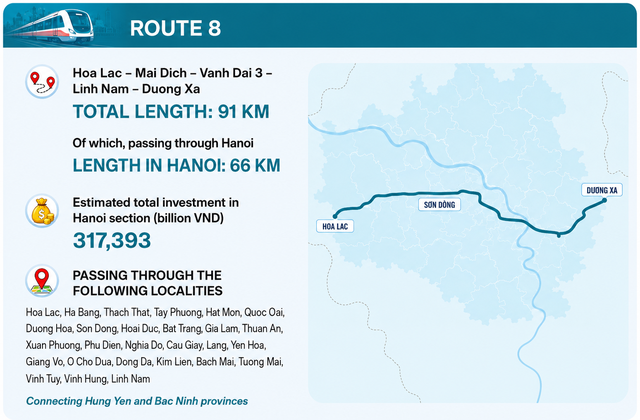
Line 8 (91 km): Links Hoa Lac Hi-Tech Park with logistics hubs, industrial zones, and eastern growth centers, strengthening economic connectivity across the capital.
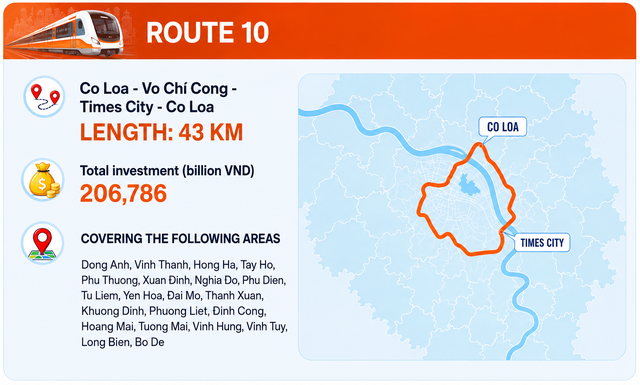
Line 10 (43 km): A circular route connecting Co Loa, Vo Chi Cong, Ring Road 3, Ring Road 2.5, and Times City before returning to Co Loa, helping ease congestion in the inner city.
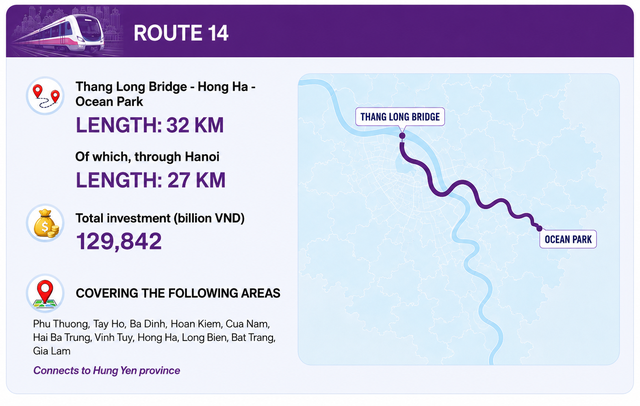
Line 14 (32 km): Extends from the Thang Long Bridge and Ciputra area through central Ha Noi to Ocean Park and eastern districts, supporting new urban expansion and enhancing regional connectivity.