
Ha Noi to pilot English as second language at 20 educational institutions
VGP - The Ha Noi People's Committee approved a pilot program to introduce English as a second language at 20 educational institutions across the capital beginning in the 2026–2027 academic year.
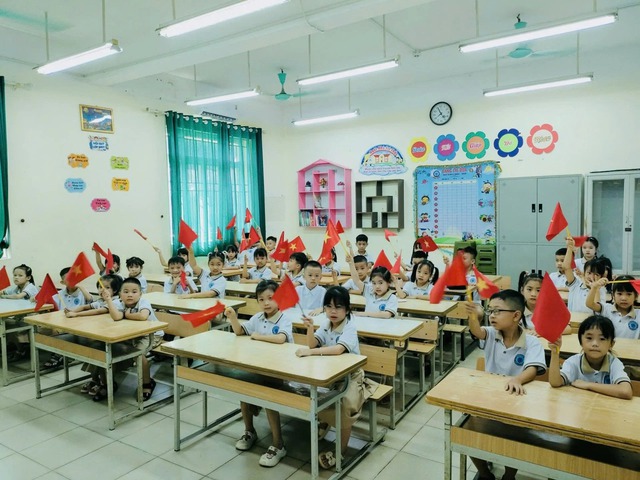
Pupils of Class 1A2, Xuan Khanh Primary School (Ha Noi City) - Illustration photo
The pilot program will be implemented at six preschools, nine general education schools, two continuing education centers, and three vocational education institutions.
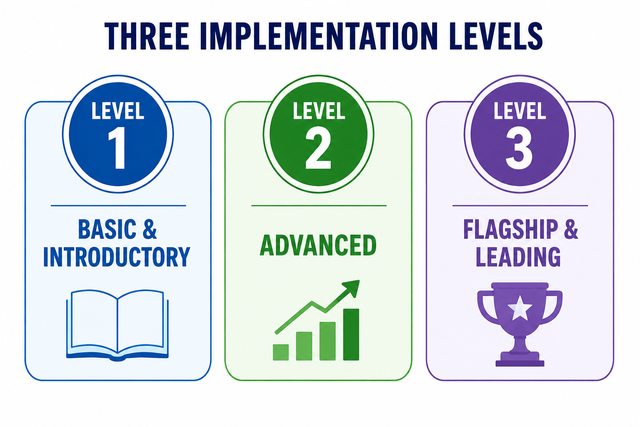
Under the plan, participating institutions will be grouped into three implementation levels based on their capacity and available resources.
Level 1 will cover institutions that are newly introducing the program or have limited resources. These schools will focus on familiarizing students with English through communication, experiential learning and daily interactions, while gradually integrating digital learning materials and educational technology into teaching.
Level 2 will include institutions with sufficient capacity to implement the program on a regular basis. They will further develop English-speaking environments, expand experiential learning and exchange activities, and increase the amount of learning content delivered in English.
Level 3 will comprise flagship institutions with strong capabilities to provide professional support and share best practices. These schools will establish immersive English-speaking environments, teach selected subjects and organize educational activities in English, and strengthen international cooperation and exchange programs.
The pilot is part of Ha Noi's roadmap to implement the national policy on English as a second language. Under the city's master plan, all educational institutions are expected to establish and maintain English-learning and communication environments appropriate to each education level by 2030.
The program is estimated to require around VND4.5 trillion (US$172 million) over the next decade, with funding mobilized from both the State budget and other lawful sources, including the private sector.
At the national level, the Ministry of Education and Training aims for English to become the second language across the education system by 2035.
To support the implementation, the ministry estimates that the country will need an additional 12,000 English teachers at the preschool level and 10,000 at the primary level to serve approximately 50,000 schools and 30 million learners nationwide.
The ministry also plans to train at least 200,000 teachers capable of delivering subjects in English by 2030.
Earlier, the Prime Minister issued Decision No. 2371/QD-TTg dated October 27, 2025, approving the Programme entitled “Making English the Second Language in Schools for the 2025–2035 period, with a vision toward 2045” (the Programme).
Accordingly, the overall objective of the Programme is to make English the second language in schools in Viet Nam, where English is widely, regularly, and effectively used in teaching, communication, administration, and other educational activities; to establish an ecosystem for the use of English in educational institutions from Level 1 to Level 3; and to improve the quality of teaching English and teaching in English, thereby contributing to building a generation of global citizens capable of meeting Viet Nam’s requirements for international integration.
Accordingly, all schools are required to teach English as a compulsory subject from grade 1. Among them, at least 20 percent of schools must reach Level 1 in teaching this language, 5 percent Level 2, and 2 percent Level 3. In the following years, the number of schools reaching Level 3 will gradually increase to 15 percent while Levels 2 and 1 will account for 20 percent and 50 percent, respectively.