Public investment fuels Ha Noi’s growth momentum
VGP - Ha Noi has stepped up the disbursement of public investment capital, reinforcing its role as a key driver of economic growth while creating momentum for the capital city's long-term development.
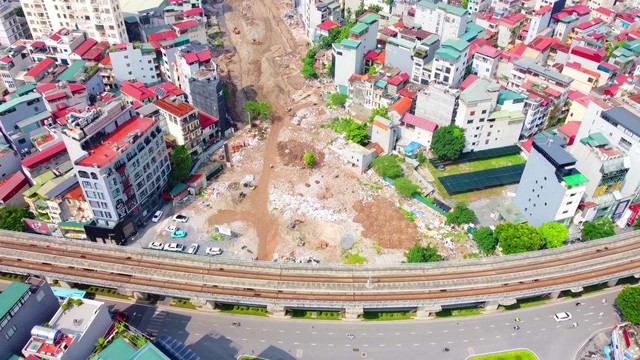
Construction is also advancing on Ring Road No. 2.5 at Duong Dinh Nghe street
In the first half of 2026, the city disbursed VND 64 trillion (US$2.4 billion) in public investment, equivalent to more than 53 percent of the annual plan assigned by the Prime Minister. This marked the highest mid-year disbursement rate recorded in recent years.
The city is currently implementing site clearance for around 1,428 projects, including 1,281 financed by the State budget and 27 large-scale strategic projects.
Significant progress has been made on major transport infrastructure. Site clearance for the Hoang Cau–Voi Phuc section of Ring Road No. 1 has been largely completed, while Ring Road No. 4 in the Capital Region has reached more than 98.8 percent of its land clearance target, with about 1,426 hectares handed over for construction. The remaining technical infrastructure is scheduled for completion in the second quarter of 2026.
Construction is also advancing on Ring Road No. 2.5, where contractors are carrying out drainage works, culvert foundation installation and roadbed construction along the Dich Vong–Duong Dinh Nghe section.
Beyond road projects, Hanoi is accelerating the construction of new bridges across the Red River in preparation for APEC 2027. The city is also investing in drainage systems and regulating lakes, including those at Me Tri, Cu Khoi, Yen Nghia 1 and 2, Phu Do and Thuy Phuong, to improve flood resilience and support sustainable urban development.
To facilitate the implementation of key infrastructure projects, Hanoi has proactively developed social housing for households requiring resettlement from major construction sites, including Ring Roads No. 1 and No. 2.5 and Tu Lien Bridge. The resettlement programme has helped safeguard residents' interests, strengthen public support and expedite land clearance.
The city's robust public investment program has also generated positive spillover effects across the economy. In the first six months of 2026, the value of construction output was estimated at VND 235.7 trillion, up 18.7 percent compared to the same period last year.
Director of the Hanoi Department of Construction Nguyen Phi Thuong said public investment should not only finance infrastructure projects but also serve as a catalyst for socio-economic development by attracting private investment, unlocking new growth drivers and enhancing the city's competitiveness.
Vice Chairman of the Ha Noi People's Committee Nguyen Xuan Luu said the city is mobilising all available resources to achieve double-digit economic growth, with priority given to strategic transport infrastructure, urban railway development, digital infrastructure, high-tech parks and transit-oriented development (TOD) projects.
He added that Ha Noi will continue removing bottlenecks related to land clearance, construction material supply and investment procedures while further decentralising authority to project investors.
At the same time, city agencies have been instructed to develop detailed capital disbursement roadmaps and strengthen accountability by linking implementation progress to the performance of agency heads, thereby improving the effectiveness and efficiency of public investment management.
Ha Noi is currently advancing a series of strategic projects under National Assembly's Resolution No. 258, including the Red River Scenic Boulevard, the Olympic Sports Urban Area, the Digital Technology and Mixed-Use Park, the Medical Complex Zone and two multi-purpose urban areas in Dong Anh, Thu Lam, Phuc Thinh and Me Linh communes.
These large-scale projects will significantly influence economic growth and the future expansion of Ha Noi's urban development space. However, site clearance and resettlement planning must be carefully prepared to avoid situations in which residents are forced to live in temporary housing for prolonged periods, as occurred in some previous projects.
As of early July, the city has revoked 24 behind-schedule projects. Land recovered from these projects will be prioritized for public facilities such as schools, hospitals and essential social infrastructure./.