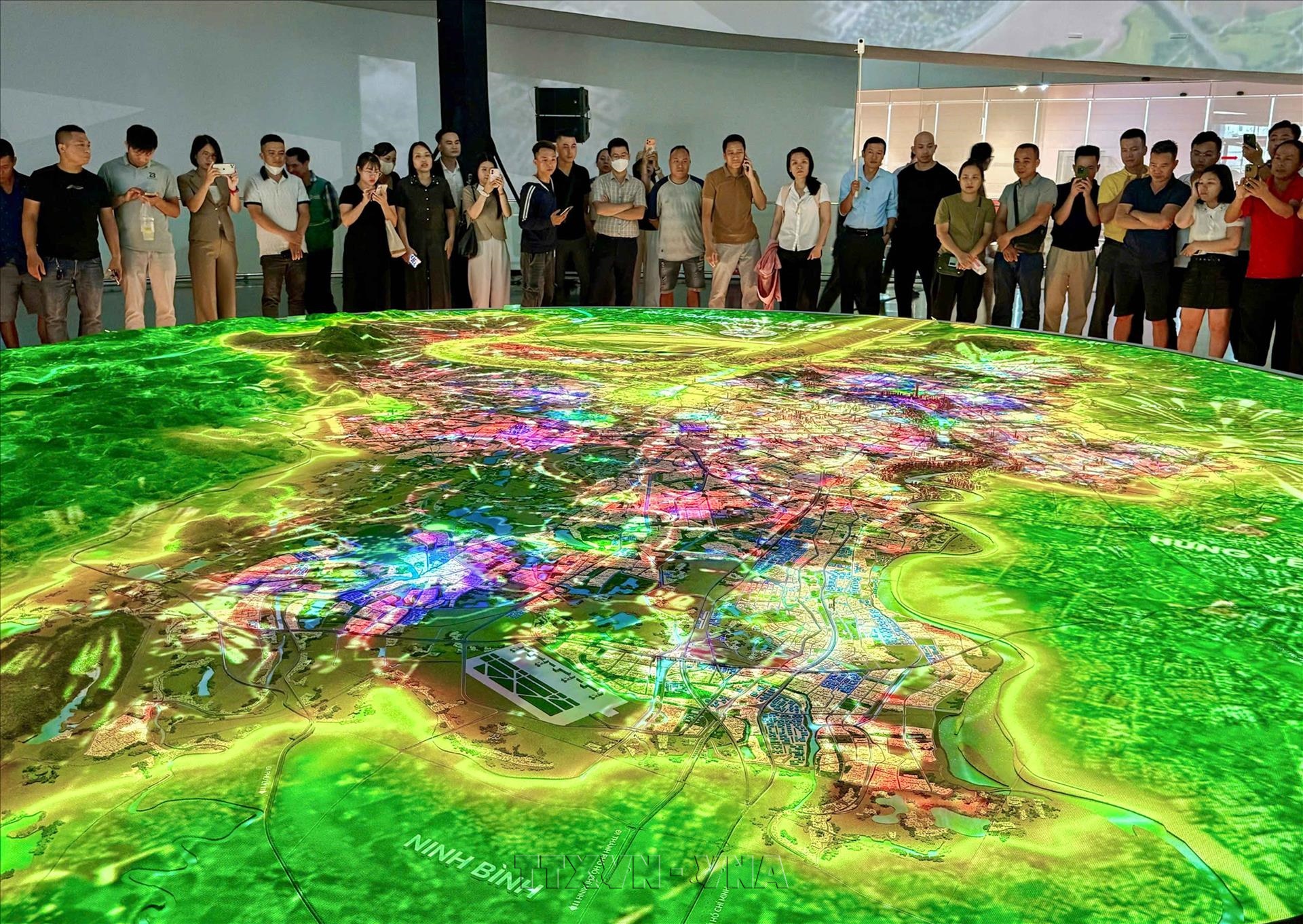
A large crowd views the master plan for the capital city of Ha Noi via a model scale using 3D mapping projection technology. Photo: VNA
The Ha Noi Capital Master Plan with a 100-year Vision identifies culture as a core value underpinning all aspects of development. It is regarded as an endogenous resource, a source of soft power and a key driver of sustainable growth.
This vision is reflected in the goal of building a "Cultured-Civilized-Modern-Happy" capital, with people placed at the center—as the subjects, beneficiaries and driving force of development.
Looking beyond 2085, Ha Noi envisions a "Prosperous-Harmonious-Cultured-Distinctive" capital that is globally connected while remaining firmly rooted in its thousand-year-old cultural heritage and serving as a meeting point for trade, knowledge and innovation.
The most significant innovation of the master plan lies not in constructing more cultural facilities or expanding the inventory of heritage sites, but in fundamentally changing the role of culture—from an asset that simply requires preservation into a dynamic engine for development. It also reorganizes the city's cultural landscape by integrating it with urban planning, natural landscapes and contemporary life.
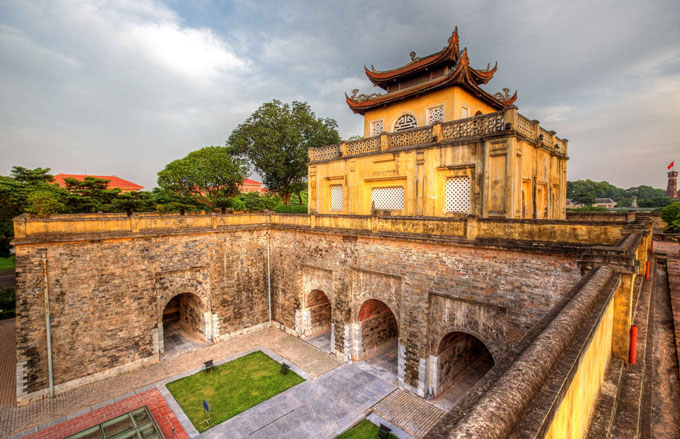
Central Sector of the Imperial Citadel of Thang Long – Ha Noi. The Central Sector is positioned in the center of Ha Noi and it is widely known as the crucial part of the Imperial Citadel of Thang Long. With the role of bearing cultural and historical meanings as well as the development process of an Asian nation for over one thousand years, it has become the 900th site on the World Heritage List by UNESCO in 2010.
Creating an interconnected heritage network
Ha Noi is home to the country's largest concentration of cultural heritage, with nearly 6,000 historical and cultural relics, thousands of items of intangible cultural heritage and numerous UNESCO-recognized heritage sites.
Pham Tuan Long, Director of the Ha Noi Department of Culture and Sports said that these are not merely statistics but living testimonies to the formation and development of Thang Long, Dong Do and present-day Ha Noi over many centuries.
Rather than treating heritage as something to be "frozen" for preservation, the Capital Master Plan views it as a valuable development resource. Within the city's development framework of nine growth poles, Ha Noi's rich heritage will serve as the historical, cultural and civilizational foundation that shapes the identity of each urban area.
He emphasized that heritage is not an obstacle to modernization but the very element that enables a modern city to retain its unique character. This philosophy is clearly reflected in the spatial planning strategy of the 100-year master plan.
Instead of preserving individual monuments in isolation, the plan establishes large-scale cultural corridors and interconnected heritage networks.
Most notably, it proposes four major heritage, cultural and landscape corridors stretching along the Da, Red and Duong rivers, with a combined length of approximately 150 kilometers.
Among them, the Red River corridor is envisioned as the capital's principal landscape, cultural, historical and environmental axis. The riverbanks will accommodate public facilities, parks, cultural venues, tourism services and iconic structures supporting festivals and tourism, while seamlessly connecting the northern and southern urban areas into a unified urban structure.
The corridor is also expected to symbolize a "Cultured-Distinctive-Creative" Ha Noi and become a new landmark of the capital. It will connect with neighboring provinces in the Red River Delta and other river systems within the basin to create a distinctive ecological and economic landscape for northern Vietnam.
According to Pham Tuan Long, the Red River is regarded as the "mother river"—the capital's primary cultural and landscape axis. The history of Thang Long-Ha Noi has always been closely associated with ancient villages, traditional craft villages and historical relics lining both banks of the river.
Therefore, future detailed planning will continue to expand conservation areas covering ancient villages, traditional craft villages and riverside heritage sites, preserving this "heritage axis" that links the city's past with its future urban development.
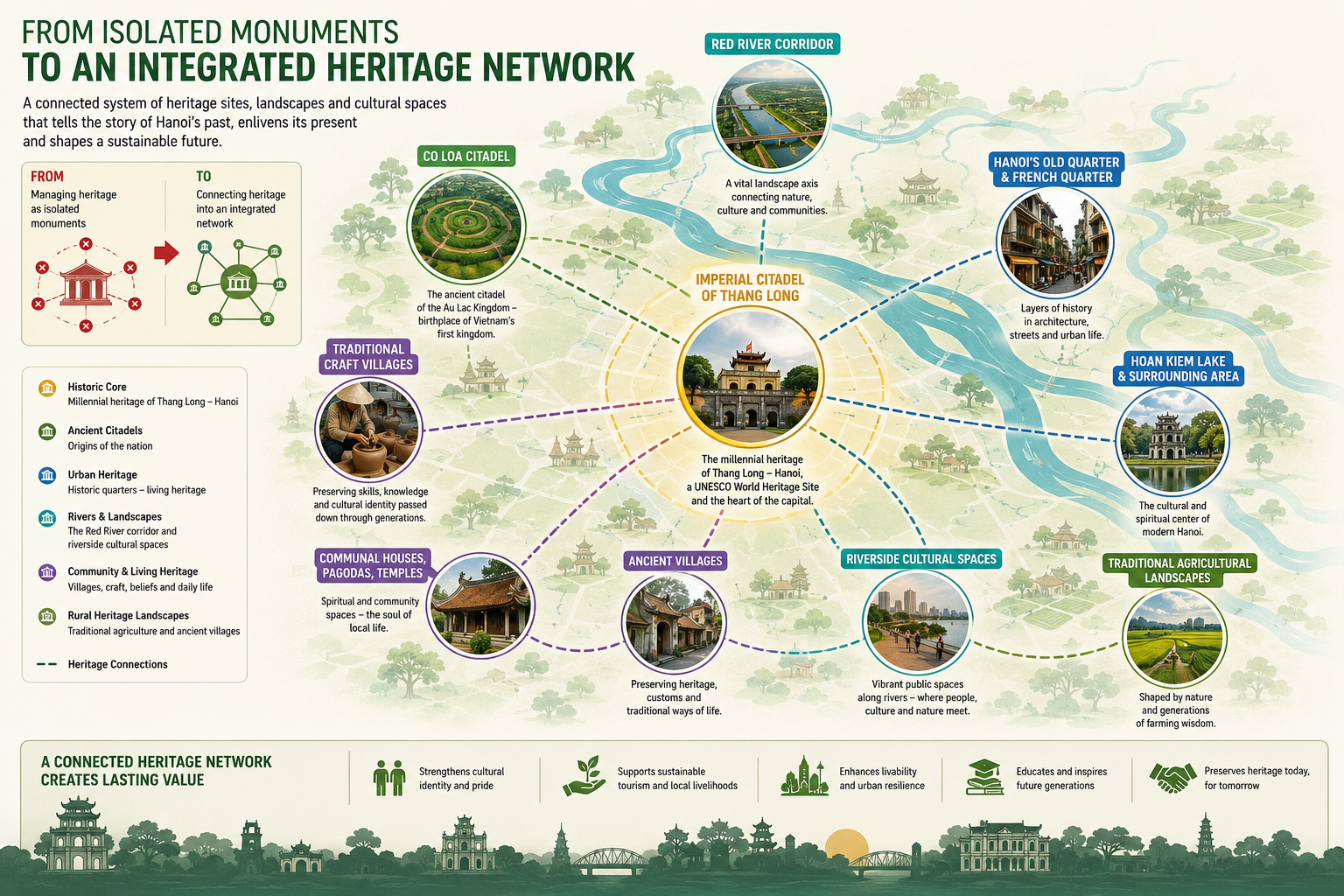
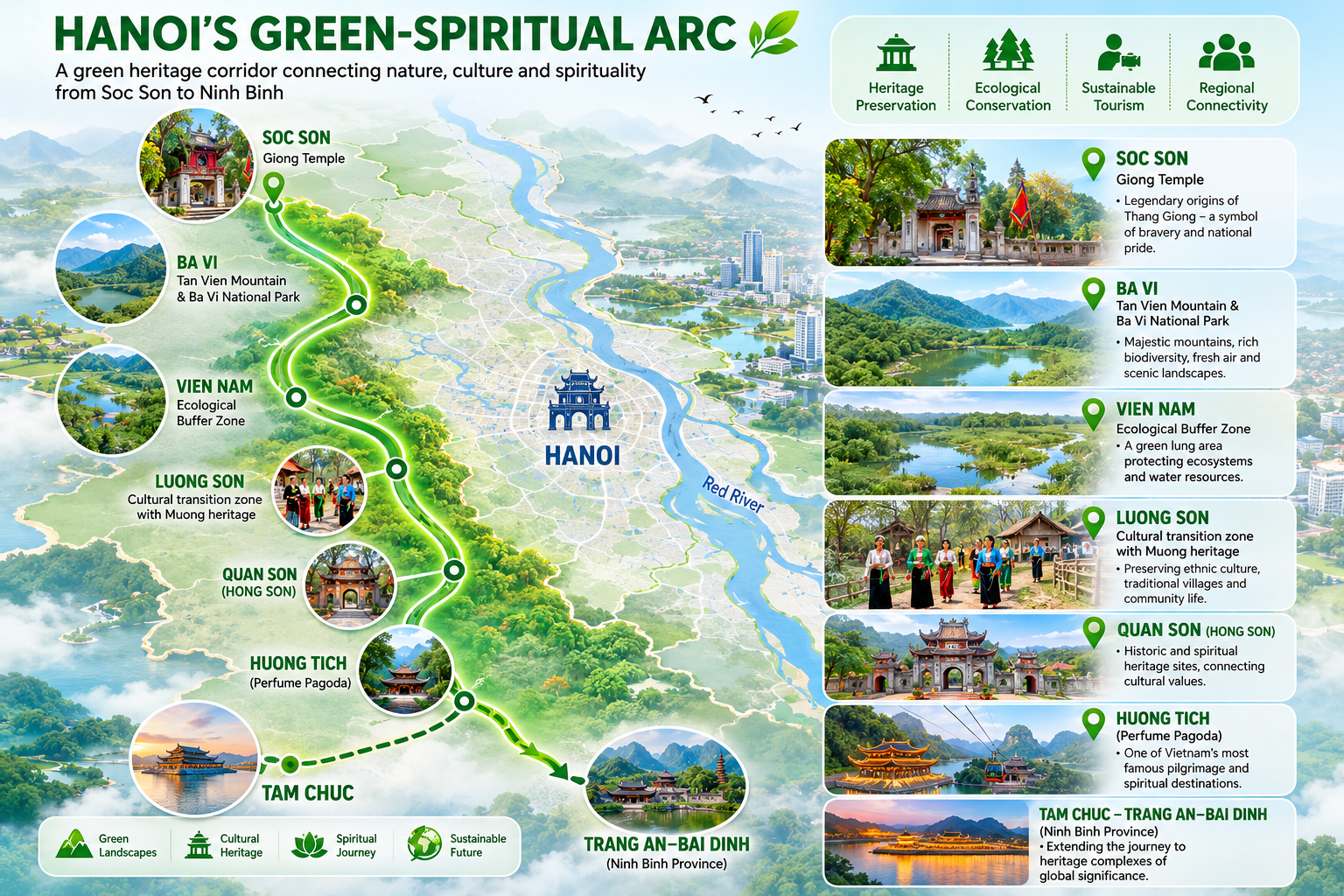
Photo with AI support
Complementing the Red River corridor, the master plan also establishes the "Green-Spiritual Arc" to the west and south of the capital. This corridor links major scenic, historical, cultural and spiritual destinations along a north-south axis, beginning at Soc Son (Giong Temple), continuing through Ba Vi (Tan Vien Mountain and Ba Vi National Park), Vien Nam ecological buffer zone, Luong Son (a cultural transition zone with Muong heritage), Quan Son (Hong Son), and Huong Tich (Perfume Pagoda), before extending to Tam Chuc and Trang An-Bai Dinh in neighboring Ninh Binh Province.
The corridor will serve both as an ecological green belt and as a regional-scale "Heritage and Spiritual Route" for tourism.
The plan also reorganizes many distinctive cultural spaces by connecting heritage sites into an integrated network rather than managing them as isolated monuments.
This network links the Imperial Citadel of Thang Long, Co Loa Citadel, Ha Noi's Old Quarter and French Quarter, Hoan Kiem Lake and its surrounding area, the Red River corridor, traditional craft villages, communal houses, pagodas, temples, ancient villages, riverside cultural spaces and traditional agricultural landscapes.
The objective is to establish integrated cultural, landscape and tourism corridors that allow residents and visitors to experience Ha Noi's heritage as a continuous cultural journey rather than a collection of disconnected destinations.
Notably, the master plan also extends beyond the historic urban core by strengthening the role of suburban heritage hubs. According to Pham Tuan Long, areas such as Son Tay Ancient Citadel, Duong Lam Ancient Village, the Huong Son scenic complex, Co Loa, together with renowned pagodas including Thay Pagoda, Tay Phuong Pagoda, Tram Gian Pagoda and Tram Pagoda, will become cultural centers supporting the sustainable development of surrounding satellite areas.
The close relationship between these heritage sites and surrounding ancient villages and traditional craft villages will help create harmony between modern urban living and traditional cultural values.
Revitalizing Ha Noi's cultural vitality
Alongside the reorganization of heritage spaces, the master plan seeks to develop a distinctive and modern cultural and creative ecosystem, making cultural industries one of Ha Noi's leading economic sectors.
Under the plan, Ha Noi will invest in a comprehensive network of modern cultural infrastructure, including a City Center for Arts and Culture, cultural industry complexes integrated with commercial and service functions, new professional performing arts venues, an expanded public library network, cultural and artistic exhibition spaces along both banks of the Red River, and the transformation of the Duong River waterfront into a complex of eco-tourism services, themed parks, sports facilities and community spaces. The city will also continue preserving and promoting the value of cultural and historical sites and landscapes to support economic and tourism development.
A key project is the establishment of a National Heritage-Academic and Academic Diplomacy Space at No. 19 Le Thanh Tong Street, based on the concept of "dynamic preservation," combining heritage conservation with academic research, intellectual exchange and the development of cultural and knowledge-based products.
The master plan also calls for building a comprehensive ecosystem for cultural industries and creative startups through creative clusters, creative industrial parks and internationally scaled innovation complexes. Ha Noi also aims to host annual international festivals and arts events, reinforcing its position as a regional center of creativity.
The city plans to digitize and map all classified relics, national treasures and documentary heritage, establish an integrated cultural database, and apply Geographic Information System (GIS) technology to heritage management, conservation and promotion.
At the same time, Ha Noi will study and prepare nominations for several cultural sites to be recognized by UNESCO as World Heritage sites, including Bat Trang Pottery Village, the Co Loa relic complex, the Huong Son scenic complex, the Ho Chi Minh Mausoleum complex, K9-Da Chong historical site and Long Bien Bridge. These efforts aim to preserve and promote heritage values while strengthening Ha Noi's image as a global city.
Strong investment momentum for cultural development
At the recent conference announcing the Ha Noi Capital Master Plan with a 100-year Vision and promoting investment opportunities, organized by the Ha Noi People's Committee, nine of the 50 memoranda of understanding (MOUs) signed were directly related to culture and social development.
To implement the master plan, Pham Tuan Long said the Ha Noi Department of Culture and Sports is carrying out action programs under the direction of the municipal Party Committee and People's Committee, while expanding cooperation with universities, businesses and investors to develop cultural industries and bring public art closer to urban life.
Mobilizing social resources is expected to help transform the master plan's strategic orientations into vibrant cultural spaces that serve residents while creating new drivers of growth for the capital.
According to experts, placing culture at the heart of Ha Noi's long-term development strategy not only demonstrates the far-reaching vision of the Capital Master Plan with a 100-year Vision but also introduces a new model for urban development.
As heritage corridors take shape, cultural spaces become increasingly interconnected and the creative ecosystem continues to mature, culture will no longer represent only the historical memory of Thang Long-Ha Noi. It will become the foundation of the capital's identity, competitiveness and sustainable development throughout the next century./.